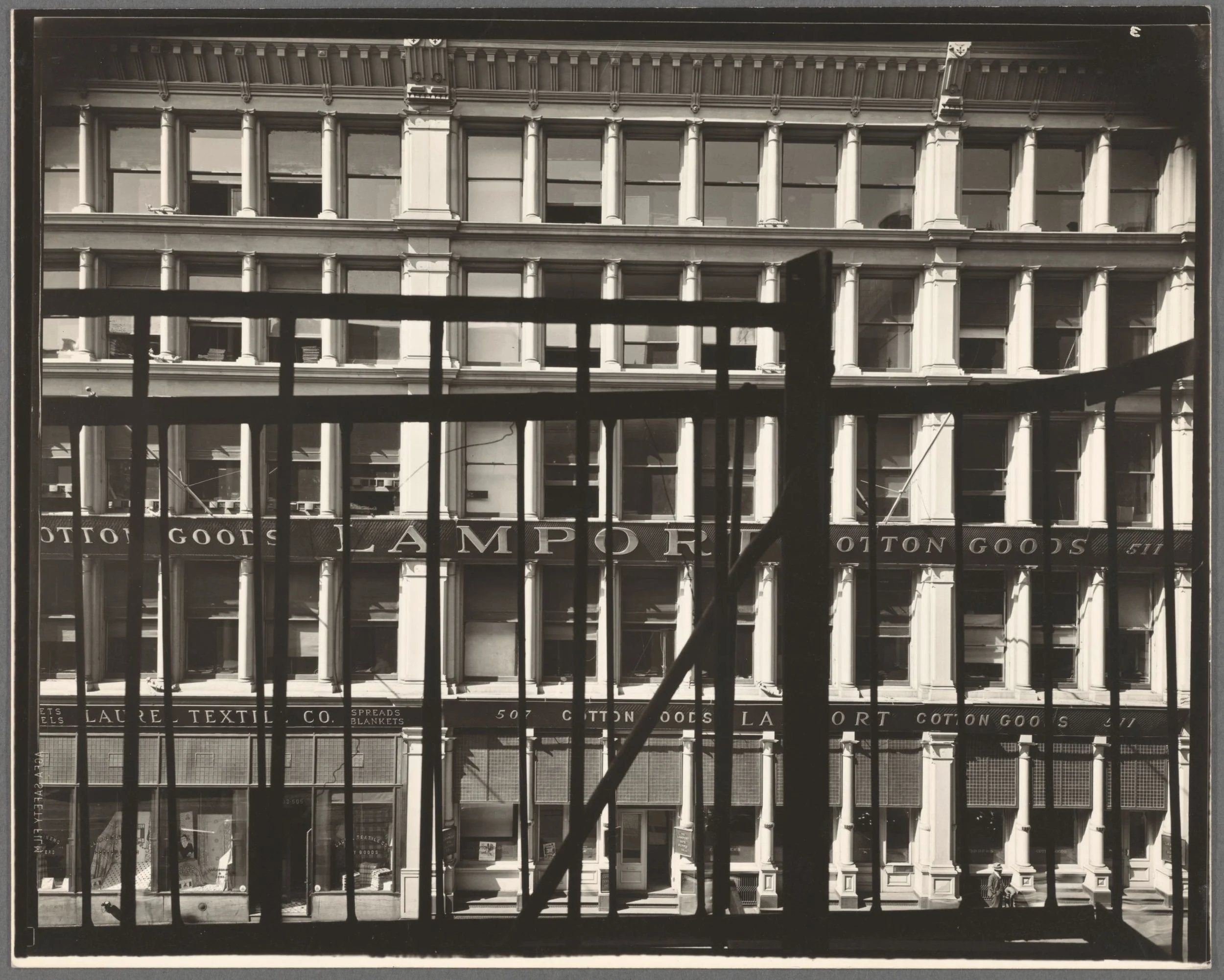
The outlines of the story are well-known. A young woman with artistic aspirations, hailing from rural Ohio, arrives in Paris in 1921 by way of New York City. Berenice Abbott, who wanted to be a sculptor, eventually took a job as a darkroom assistant for Man Ray, the American surrealist, in order to support herself. She knew nothing about photography—that was, in fact, a requirement for the job—but quickly learned while working with Ray. She began to do portrait work of her own, initially sharing Ray’s studio and later going her separate way, becoming established as a portrait photographer of some renown.
Abbott was a Modernist, who viewed Pictorialism, with its emphasis on soft focus, print manipulation, and classical themes as escapism; a denial of modern urban life. She was particularly taken with the work of Eugène Atget, the pioneer of documentary photography, who years before had set about photographing Paris street scenes systematically, documenting everything he believed to be "artistic and picturesque." In fact, she did much to rescue Atget from obscurity, even if this recognition did not start until the very end of his life. She purchased most of his plates and prints upon his death, in 1927, and decided to come to the New York City two years later to look for a publisher for Atget's work on his “immense subject.” She would end up staying, having found her own immense subject.
Seeing the country of her birth through the eyes of an expatriate, she “felt keenly the neglect of American material by American artists.” She believed that, to properly understand it, the country should be "approached with love void of sentimentality, and not solely with criticism and irony." Carrying out this work proved difficult at first. The arrival of the Great Depression meant much fewer people had the disposable income necessary to have their portrait done by Abbott. She had to scramble to make a living, and this left her little time to photograph New York. It wasn't until 1935, when her application to the Works Progress Administration was accepted, that she would turn her full attention to the project that would define her, namely, Changing New York.
Needless to say, I also find New York to be an immense, and often overwhelming, subject. Where does one even start? I asked Berenice Abbott for directions.